Showing posts with label origin. Show all posts

Tuesday, 18 June 2019

Surprising origin of the word grotesque

Sitting in the waiting room at my doctor's surgery, I read an article in an old edition of National Geographic and was surprised to learn the origin of the word grotesque.

The article was a revisiting of the life and achievements of the emperor Nero, a bad guy by anyone's measure, but apparently a man with an artistic vision that resulted in an amazing palace, one largely open for the common people to stroll around the grounds.

He built a huge palace that took up a large portion of the Roman city (land available because of the infamous fire that he may or may not have instigated.)

Subsequent emperors appear to have hated Nero so much that they literally buried Nero's palace. One report said some areas were filled with sand, which is why the interior was preserved so well, at least until the fifteenth century.

For fifteenth century artists, it was a popular pilgrimage to be lowered into the cave-like interior of the buried palace to look at the frescoes on the ceilings. Apparently the fill of rubble meant that these early visitors were standing up near the ceiling, and could touch the painted surfaces.

They were so taken with the paintings that they reproduced many of the motifs of these grotesque (i e from a cave or grotto) artworks in their own work. I guess if we did our homework we could figure out where to see them, probably some in the Vatican, I suppose.

The Online Etymology Dictionary writes that this suggested origin of the word grotesque is generally accepted.

Here are a few links that I've just enjoyed looking at.


Monday, 6 June 2016

Dickens and the origin of the word boredom

One of the many problems with the internet is that we can inadvertently perpetuate myths. It seems I've done this myself, in my post about the origin of the word boredom.

I'd been watching an episode of QI in which Stephen Fry said Charles Dickens coined the word.

I'm glad that I make no pretence about being an expert on language. I'm just a person who's interested in words. So I guess I don't have to be too embarrassed about my lack of proper research. (Of course, I'm a teensy bit red in the face.)

Paul Vargas has gone to original sources, having read texts where the word was in print in 1838, 1847 and 1844, amongst others. Those texts predate the supposed first use of it by Dickens in 1852. Vargas' blog post is well worth a read.

Dictionary.com has similar information. The writer says:
Charles Dickens is often given credit for inventing words that he was not the first to use. This is not surprising, if only because he was much more widely read than some of the people who had used these words before him. Dickens was also far more attuned to the language of the streets than were most of his contemporaries, and so his writing contains many examples of recently-invented terms. Writing in the Quarterly Review in 1839, Richard Ford refers to Dickens as the "regius professor of slang."

I'm grateful to Paul Vargas for alerting me to my error.

Tuesday, 4 September 2012

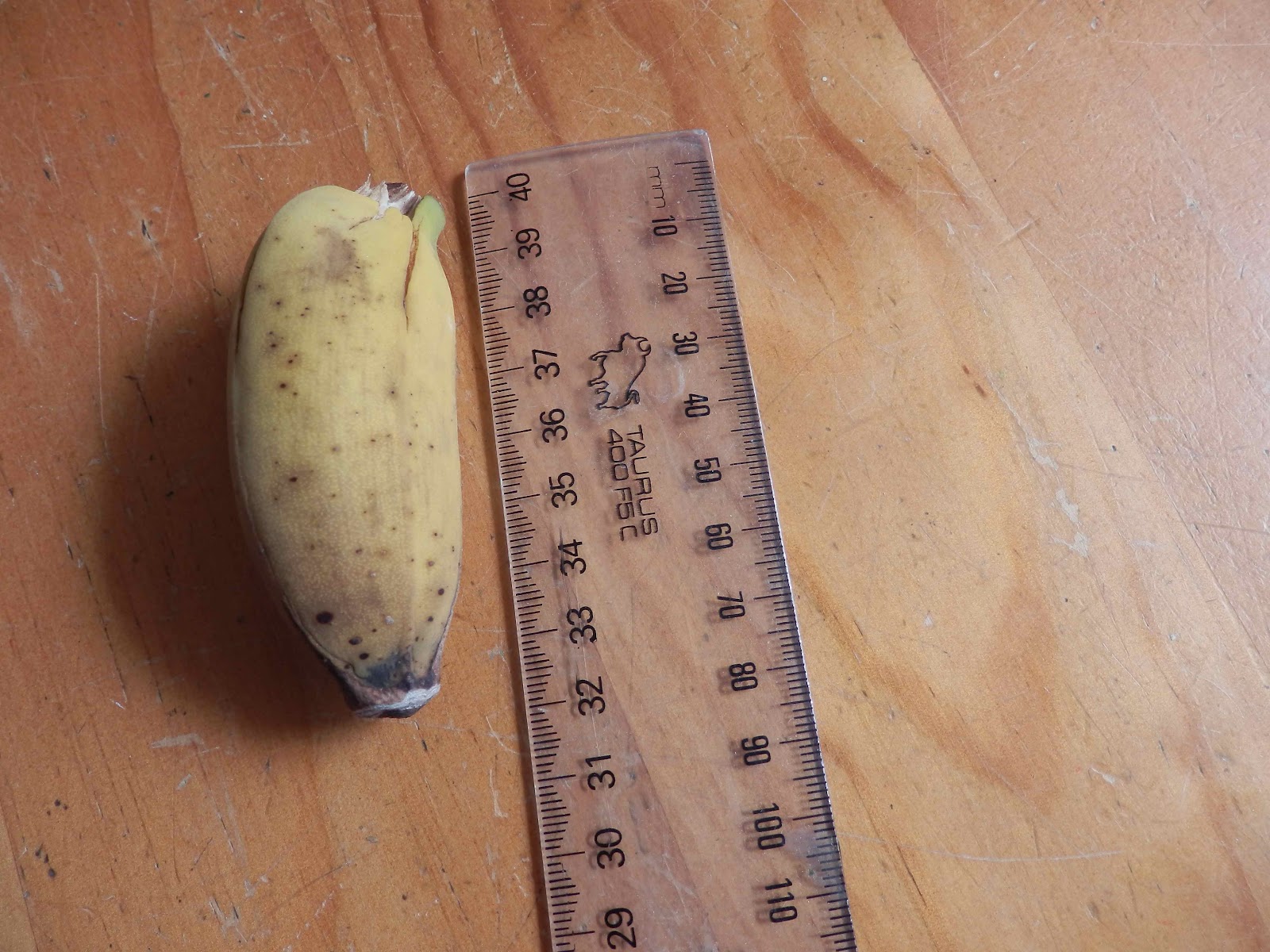
bananas can grow and ripen in Melbourne

For weeks I've walked past a house in Melbourne with a banana plant in the front yard.  Not many people grow them here, because it's thought the climate is too cold. However, I had heard that's not true, so it didn't seem so very out of the ordinary. 


But this plant had fruit  on it. And that's rare so far south.

So today, when I noticed the bunch had disappeared, I just had to open the front gate, walk up the path and knock on the door to ask whether the fruit had ripened.


And it had! I wouldn't have thought the tail-end of a cold winter was the time to harvest a tropical fruit.
Not only did the lady who came to the door answer my question, but she gave me a banana to take home.


As you can see, it was only about nine centimetres (3 1/2 inches) long. But it was delicious, sweeter than the bananas we buy from the shop.

My dog, Penny loves bananas, but she didn't get any of this precious one.


We sometimes like to joke that Penny goes bananas for bananas. I wondered where the expression comes from. The origin of the phrase is unclear. Some say that it relates to the old expression to go ape, because of the connection with apes eating bananas. There's a theory that it might be connected to the myth that eating banana skins can give a hallucinogenic experience.

World Wide Words says the phrase to go bananas dates only from the 1960s.
What of to go bananas? It burst upon the world in the 1960s and became a fashionable, not to say faddish, term in the 1970s. Its heyday is over, perhaps thankfully so. But nobody seems to have any very clear idea where it came from. Was the idea of something bent at the root of it, so that a person was being driven mentally out of shape? Or was there a mental image of an over-excited ape clamouring for his daily feast? Or was it a more subtle image connected with the older phrase to go ape or evento go nuts? You can go crazy thinking about this stuff.

By the way, in researching this topic, I've been reassured that bananas are okay for dogs to eat. (There's a good photo of a banana plant at the ASPCA site.)

Tuesday, 29 May 2012

more about the origin of the word 'kangaroo'

Following a link on the 6Ablog, I found an informative little video clip about the word kangaroo.
A discussion on a forum called QI also has information about this word's origin. Judy Bennett says:
Lieutenant James Cook beached his 'HM Bark Endeavour' in what is now Cooktown, in 1770 having damaged his ship on the Great Barrier Reef. He remained in the area for nearly seven weeks. The word 'kangaroo' was first recorded in the ships' journals during this time, and the animal was also drawn by Sidney Parkinson. The journals are held at the James Cook Museum in Cooktown. The first sighting of the animal was on June 24th 1770. They tried to shoot one for quite some time, finally Lieut. John Gore succeeding on July 14th. It was eaten at supper the following day.
I've posted about this word previously.