Showing posts with label Melbourne. Show all posts

Wednesday, 13 July 2022

the benefits of research in a second language

 It has been a long time since I put anything new here. I'll just write a quick post to keep the blog alive. 

At the beginning of the long lockdowns here in Victoria, Australia, I, like many others, was looking for some intellectual stimulation to help me deal with the stress.

It occurred to me to take up my study of German again, after many decades of not reading or speaking the language. 

I was very lucky to come across a great class run by the CAE here in Melbourne - German language online.

At first, to me it was a matter of learning the language, then after a while it became learning in that language, and finally I've arrived at the stage where it's learning about things in the new language.

This ability to discover information in German has opened up many new doors for me. For instance, recently my dog Peppa had a grass seed in her foot. (Major bother and major expense.) When I went to the vet today for what I hope is the final check-up on her recovery, he told me how grass seeds drill into the flesh of dogs, and are formed in such a way that they resist being pulled out.

I felt quite pleased to say that I'd read about this recently on a German website. I'd visited lots of blogs and webpages about the problem, as any concerned dog owner would, but that specific piece about the structure of grass had been in German. 

I'd taken notice of it because I was looking for the translation of the word Grannen on the German site: the word means awn in English. Wikipedia has a rather scary explanation of how the awns of wild emmer wheat bury themselves in the soil. I'd better not go down that rabbit hole, or I'll never take my dog to a grassy area again. Here's hoping the grasses around here are less active. 

Knowing German is great fun, because there's so much of the internet to explore.

Sunday, 15 June 2014

gaol or jail?

I'm pleased that one of my stories has been published online at World City Stories. It's set in  a museum in  a former prison in central Melbourne in Australia.
The museum is called The Old Melbourne Gaol.


When I was a child, 'gaol' was the accepted spelling for this word, but it's been many a year since I've seen it written this way in any other Australian context.
I've always wondered why it's pronounced like 'jail', when it's a g followed by an a, and a Google search using the terms 'etymology gaol' clears up the mystery. It used to be pronounced with a hard g.
Middle English; based on Latin cavea (see cage). The word came into English in two forms, jaiole from Old French and gayole from Anglo-Norman French gaole (surviving in the spelling gaol), originally pronounced with a hard g, as in goat.
 An article from 5 April 2014 in The Spectator gives a more in-depth look at the history of these two spellings. I particularly enjoyed the passing references to such interesting linguistic oddities as 'Go to jail. Go directly to jail. Do not pass Go. Do not collect £200'; gaggia (as in the coffee machines); and rage.

Linguistic change over time is fascinating.

Tuesday, 4 September 2012

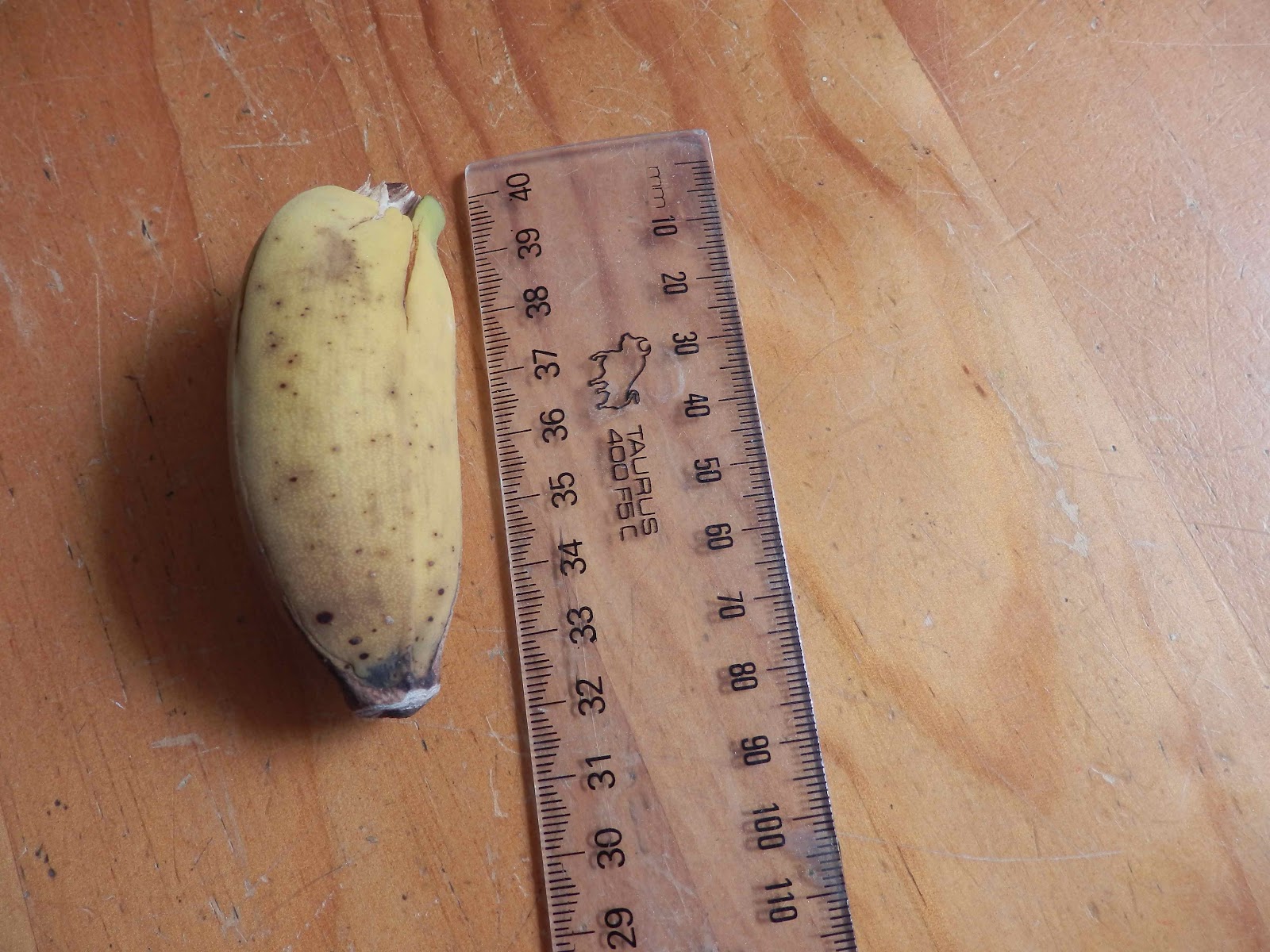
bananas can grow and ripen in Melbourne

For weeks I've walked past a house in Melbourne with a banana plant in the front yard.  Not many people grow them here, because it's thought the climate is too cold. However, I had heard that's not true, so it didn't seem so very out of the ordinary. 


But this plant had fruit  on it. And that's rare so far south.

So today, when I noticed the bunch had disappeared, I just had to open the front gate, walk up the path and knock on the door to ask whether the fruit had ripened.


And it had! I wouldn't have thought the tail-end of a cold winter was the time to harvest a tropical fruit.
Not only did the lady who came to the door answer my question, but she gave me a banana to take home.


As you can see, it was only about nine centimetres (3 1/2 inches) long. But it was delicious, sweeter than the bananas we buy from the shop.

My dog, Penny loves bananas, but she didn't get any of this precious one.


We sometimes like to joke that Penny goes bananas for bananas. I wondered where the expression comes from. The origin of the phrase is unclear. Some say that it relates to the old expression to go ape, because of the connection with apes eating bananas. There's a theory that it might be connected to the myth that eating banana skins can give a hallucinogenic experience.

World Wide Words says the phrase to go bananas dates only from the 1960s.
What of to go bananas? It burst upon the world in the 1960s and became a fashionable, not to say faddish, term in the 1970s. Its heyday is over, perhaps thankfully so. But nobody seems to have any very clear idea where it came from. Was the idea of something bent at the root of it, so that a person was being driven mentally out of shape? Or was there a mental image of an over-excited ape clamouring for his daily feast? Or was it a more subtle image connected with the older phrase to go ape or evento go nuts? You can go crazy thinking about this stuff.

By the way, in researching this topic, I've been reassured that bananas are okay for dogs to eat. (There's a good photo of a banana plant at the ASPCA site.)

Saturday, 4 August 2012

origin of the phrase 'rule of thumb'

At a workshop today about edible weeds, we discussed the danger of tasting unknown plants, and the group agreed that it would be generally safe to try a tiny piece of foliage from a plant. (But I guess it would be most unfortunate if anyone tried that on a poisonous toadstool.)

One participant said he'd heard the phrase 'rule of thumb' originates from the idea that it's fairly safe to try a piece of leaf that's smaller than a man's thumb.

I can't see any references to this origin on the Internet. In fact, it seems more likely that the phrase comes from the use of the thumb as a rough measure of length. Wikipedia points out:
 The use of a single word or cognate for "inch" and "thumb" is common in many other Indo-European languages, for example, Frenchpouce inch/thumb; Italianpollice inch/thumb; Spanishpulgada inch, pulgar thumb;Portuguesepolegada inch, polegar thumb; Swedishtum inch, tumme thumb; Sanskritangulam inch, anguli finger; SlovakpalecSlovenepalec inch/thumb, Czechpalec inch/thumb.
By the way, it was a great workshop. I as I've said before and before and before, our thinking often depends on the words we use. If I call this lovely little plant a weed, it might irritate me to see it growing in my garden.


But if I call it a herb, or even a potherb, or just plain old 'food', then it's a different story. I think it's chickweed, but I'm not sure enough to say so straight out. I'd better sign up for another weed workshop, or perhaps I should consult Doris Pozzi's handbook of edible weeds. (She presented the workshop.) 

Tuesday, 15 December 2009

at last, a photo of Kathryn/e street that is nearly visible

Here's a pretty good nother try at photographing the strange additional letter on the sign for Kathryn Street on the Metropolitan Ring Road in Melbourne.


Oh, I would so-o like to know who did it and why.

Wednesday, 27 August 2008

talking to authors

This evening I went to Rendezvous, the Romance Bookshop, because a group of well-known writers were signing their books. They are in Australia for the Romance Writers of Australia Conference, which finished three days ago.

I felt hesitant to go, because I tend to freeze when I meet authors and usually produce a glacial silence, interspersed with bursts of gibberish as I try to squeeze out some intelligent talk. But my sister was the keen fan tonight, so I felt relatively relaxed; I was just moral support.

And then she wandered off.

There I was standing beside Jo Beverley. I've read many of her novels, but 'author phobia' set in and I couldn't remember any of them. I thought I'd better say something, so I asked, 'How much research do you need to do, considering you know your period so well?' It seemed a safe enough question, because I know her historical detail is always accurate.

And the conversation went from there. It was inspiring to a wannabe writer like myself.

Here's some of what I remember of the discussion.
  • Her plot evolves as the events and characters lead her.
  • If she didn't take pleasure in writing a book, it's likely her readers wouldn't enjoy it either.
  • She usually works about four hours a day.
  • Generally she will read back a couple of hundred words of what she wrote the previous day as she starts a new session.
  • She doesn't let her 'internal critic' loose on the first draft and if she can't think of a particular word, she types in symbols as place-holders.

In describing her technique for building characters, Jo used the metaphor of a sculptor building a figure in clay. First she pulls together a rough shape and then adds layers of detail. Which gives me the chance I've been waiting for - to use my newest verbal acquisition. Her characters are made of clay but they don't have argillaceous feet.

And if you don't know what that second-last word means, you might like to subscribe to one of my favorite email services - A. Word. A. Day. If you do, you'll get one interesting or unusual word mailed to you each day.

Today's word was 'argillaceous'; meaning made of, resembling, or relating to clay: clayey.