Showing posts with label etymology. Show all posts

Saturday, 30 March 2024

Maundy and maun

 At church on the Thursday night before Easter, I was most interested to hear in the homily that the older name for that day is 'Maundy Thursday'. We generally call it 'Holy Thursday'. 

The priest said that the older meaning was that Christ gave us a 'mandate' to love one another and serve each other humbly - as he demonstrated in washing the the feet of his followers. Sure, when I looked around the internet, the same definition popped up.

A Scottish word then occurred to me - maun. When I looked up the meaning, there is was: Maun means must.

Saturday, 11 January 2020

New Year, new post

First post of 2020 - hopefully not the only one!

Many months ago, a bothersome sales rep managed to corral me into listening to his spiel about a body lotion, and the small sachet he gave me as a sample has been sitting on my chest of drawers, waiting for me to use it. (I'm not going to waste it, because I'm a fanatic about making use of all the world's resources, even a three-centimetre square packet of body lotion.)

Today I noticed the wording on it:


My decades-old schoolgirl French suggested that the word Lavande has something to do with washing, so I looked up the origin of lavender at The Online Etymology Dictionary.

Sure enough, I had remembered correctly (reassuring, at my age, to know my memory still works).

Here's what it said:

lavender (n.)"fragrant plant of the mint family," c. 1300, from Anglo-French lavendre, Old French lavendre, "the lavender plant," from Medieval Latin lavendula "lavender" (10c.), perhaps from Latin lividus "bluish, livid". [This was followed by a  referral to a link for the word livid,  in relation to whether livid means purple-colored or pale-colored.]  If so it probably was associated with French lavande, Italian lavanda "a washing" (from Latin lavare "to wash;" from PIE root *leue- "to wash") because it was used to scent washed fabrics and as a bath perfume.

So far, interesting, but nothing I hadn't expected. However, the next bit fascinated me: 

The adjective meaning "of a pale purple color, of the color of lavender flowers" is from 1840; as a noun in the color sense from 1882. An identical Middle English word meant "laundress, washerwoman;" also, apparently, "prostitute, whore; camp follower" and is attested as a surname from early 13c.

So, the usual disparity in use of language for female activities compared to male ones. 
And I had to spare a thought for those women who followed medieval armies. Not only did they have to provide sexual favours to their 'protectors', but had to wash the soldiers' dirty clothes too!
The Grammarphobia blog has a discussion of this word also, and it's a great read. In part, it says:
But no, the obsolete “lavender” that means a washerwoman is probably not related to the other “lavender,” the plant that produces the fragrant pale-purple flowers.
The botanical word “lavender” (later also used for the scent and the color) came into English before 1300 from Anglo-Norman and Old French (lavandre), the OED saysThe original source was a medieval Latin word for the plant, first spelled livendula (or perhaps lividula), and later lavendula. As the OED explains, some etymologists think the ultimate source may be the classical Latin adjective lividus (bluish, livid).
If so, the two “lavenders” aren’t etymologically connected, though they later became associated because of the use of lavender perfumes, oils, and dried flowers in caring for linens.
I came across an article called 'Sex and the Soldier in Lancastrian Normandy, 1415 to 1450,' with lots of information about attitudes towards women who travelled with armies, and although I didn't resolve my confusion about the etymology of the two words, I enjoyed reading it. 

Tuesday, 18 June 2019

Surprising origin of the word grotesque

Sitting in the waiting room at my doctor's surgery, I read an article in an old edition of National Geographic and was surprised to learn the origin of the word grotesque.

The article was a revisiting of the life and achievements of the emperor Nero, a bad guy by anyone's measure, but apparently a man with an artistic vision that resulted in an amazing palace, one largely open for the common people to stroll around the grounds.

He built a huge palace that took up a large portion of the Roman city (land available because of the infamous fire that he may or may not have instigated.)

Subsequent emperors appear to have hated Nero so much that they literally buried Nero's palace. One report said some areas were filled with sand, which is why the interior was preserved so well, at least until the fifteenth century.

For fifteenth century artists, it was a popular pilgrimage to be lowered into the cave-like interior of the buried palace to look at the frescoes on the ceilings. Apparently the fill of rubble meant that these early visitors were standing up near the ceiling, and could touch the painted surfaces.

They were so taken with the paintings that they reproduced many of the motifs of these grotesque (i e from a cave or grotto) artworks in their own work. I guess if we did our homework we could figure out where to see them, probably some in the Vatican, I suppose.

The Online Etymology Dictionary writes that this suggested origin of the word grotesque is generally accepted.

Here are a few links that I've just enjoyed looking at.


Monday, 4 February 2019

nurses nourish us

Recently on FaceBook I came across an advertisement promoting respect for the profession of nursing. Hilarious, but with a serious message.

I was reminded of that advertisement when I came across the word nurstle on a site where you can get help in solving crossword puzzles. The meaning was given as: 'Nurstle, to nurse. See noursle.' Noursle was defined as 'To nurse; to rear; to bring up.' 

That second spelling seemed to relate to nourishment, so I looked for the word nurse on the Online Etymology Dictionary

And yes, there it was, the origin of a role we accept as vitally important in our modern world, but don't stop to think about.

Nurses nourish us.

It seems the word comes to us from as early as the twelfth-century, in the sense of a wet-nurse.
12c., nurrice, "wet-nurse, foster-mother to a young child" (modern form from late 14c.), from Old French norrice "foster-mother, wet-nurse, nanny" (source of proper name Norris), from Late Latin*nutricia, "nurse, governess, tutoress," noun use of fem. nutricius"that suckles, nourishes," from nutrix (genitive nutricis) "wet-nurse, "from nutrire "to suckle" (see nourish). Meaning "person who takes care of sick" in English first recorded 1580s.

When the link to nourish is followed, similar root words appear.

And, then to my joy, I read that nursle is a frequentative of nurse.

Frequentative? I'd not previously come across this wonderful type of English verb. But that's a story another day.

I think I'm in love with frequentative verbs.

Wednesday, 7 March 2018

Deans as leaders of a group of ten

I am reading a book by Joan Chittister, The Rule of Benedict, A Spirituality for the 21st Century.


I find it interesting that a manual written many hundreds of years ago has so much to tell us about how to live a measured life. Joan Chittister's commentary explains how we can learn from Benedict's wisdom.

The idea is to read one section each day, but I've fallen behind and today arrived at the entry for February 26, where I  noticed this:
If the community is rather large, some chosen for their good repute and holy life should be made deans. They will take care of their groups of ten...
Whoa, I said to myself - 'groups of ten.' Hmm...dean does seem to have some resemblance to the Greek word for 'ten, or the Latin word.

So I looked it up in the Online Etymology Dictionary, and bingo! It means someone who has charge of ten people.

dean (n.)early 14c., from Old French deien (12c., Modern French doyen), from Late Latin decanus "head of a group of 10 monks in a monastery," from earlier secular meaning "commander of 10 soldiers" (which was extended to civil administrators in the late empire), from Greek dekanos, from deka "ten" (from PIE root *dekm- "ten"). Replaced Old English teoưingealdor. College sense is from 1570s (in Latin from late 13c.).

Monday, 15 May 2017

when sadness is heavy upon our soul

The word sadiron landed in my inbox today as my daily mail from A Word a Day. The meaning of the word is
noun: a heavy flatiron pointed at both ends and having a detachable handle. And the etymology is 'From sad (obsolete senses of the word: heavy, solid) + iron Earliest documented use: 1759.

When I'm sad I do feel heavy, in every limb, so I can understand how this word came to have such a meaning.

The Online Etymology Dictionary says:
sad (adj.) Old English saed "sated, full, having had one's fill (of food, drink, fighting, etc.), weary of," [and gives further detail in the full description of this word's history.] Sense development passed through the meaning "heavy, ponderous" (i.e. "full" mentally or physically), and "weary, tired of" before emerging c. 1300 as "unhappy." An alternative course would be through the common Middle English sense of "steadfast, firmly established, fixed" (as in sad-ware "tough pewter vessels") and "serious" to "grave". In the main modern sense, it replaced Old English unrot, negative of rot "cheerful, glad." 

I wonder what other utensils are sad? Surely it's not just the irons and pewter vessels.

At Words, Words, Words, the writer of the blog writes more about this history, and ends with this:
But one thing that people don't know about sadness is that it is silent. You can't spot it from a mile away, it could be right next to you as you read this. But it is not the be all and end all, you can overcome sadness, but first you have to be able to see it.

I agree. We need to keep our radar scanning for sad people around us, and also to check inside ourselves to see if we are dealing with our own sadness.

Thursday, 11 May 2017

imbricated roots

I'm reading a book about plants and loving it. It lives up to the blurb inside the front cover:
From Ice Age cave art to cutting-edge research into how mimosas learn and remember, Mabey traces the history of our imaginative encounters with them [plants] - including his own.


How could I resist such an intriguing invitation to deepen my understanding of the myriad species that share this planet?

On page 69 Mabey writes that under the ground, 'The roots and fungal tissues are as imbricated as if they were a single organism.'

I  understood the general idea of the sentence, but I just had to hurry to the internet to find out more about this interesting word imbricated.

Merriam Webster explains the history of the word imbricate:

The ancient Romans knew how to keep the interior of their villas dry when it rained. They covered their roofs with overlapping curved tiles so the "imber" (Latin for pelting rain or "rain shower") couldn't seep in. The tiles were, in effect, "rain tiles", so the Romans called them "imbrices" (singular "imbrex"). The verb for installing the tiles was "imbricare", and English speakers used its past participle "imbricatus" - to create "imbricate", which was first used as adjective meaning "overlapping" (like roof tiles) and later became a verb meaning "to overlap". 
I like to think of water percolating down through the forest floor to moisten those interwoven plant roots and fungal threads.

Mabey says:
The oldest living organisms in the world are probably the subterranean mycorrhiza of ancient forest fungi. They've been there since the woods sprang up, tens of thousands of years ago, and live in an intimate partnership with the tree roots, without which neither could survive. 
A reminder to us that we can't survive without the plants, either.
SaveSave

Saturday, 29 April 2017

grocers

I called in at a local fruit shop today to get some oranges for a favourite pumpkin soup recipe.

As I was squeezing the juice out of the oranges and zesting one of them, I thought about the fact that I call the proprietor of this type of shop a greengrocer, and I began to wonder what the connection is between a grocer and a greengrocer.

Once the soup was made, I looked at the Online Etymology Dictionary and discovered read  about the noun:
early 15c. (mid-13c. as a surname), "wholesale dealer, one who buys and sells in gross," corrupted spelling of Anglo-French grosser, Old French grossier, fromMedieval Latin grossarius "wholesaler," literally "dealer in quantity" (source also of Spanish grosero, Italian grosseiro), from Late Latin grossus "coarse (of food), great, gross"...(adj.)). Sense of "a merchant selling individual items of food" is 16c.: in Middle English this was a spicer.
I haven't ever met anyone with the surname 'Grocer'. I wonder what the variants might be.

The Word Detective has a post about the connection of this word with the word gross.
The article says the Americans invented the word grocery. In Australia when I was growing up, my family referred to such a shop as the grocer's.

The Cambridge Dictionary has the usage as grocer's in the UK.

At the forum of wordreference.com, calvindebeverley has written about the American usage:
Ok here is the deal. I have no idea what the word grocer means in any part of the world than the US so take that to heart in what follows. The word grocery and grocer in the US refers to an old type of store. It was usually owned and operated by a family, father being the grocer, and it sold many different items in "Gross" or large quantities because most people lived so far out on their ranches and farms that they needed to buy in quanity sometimes even to get them through a winter. In the southwest it meant at times also a bar or saloon but that was just because people in the Southwest are just that way! LOL. J/K. As time passed small stores that sold food retained the name grocery. Today there are very few real grocery stores in the old sense probably only found in small towns. Now the food department of say Walmart is todays grocery. And the very hard to find "helper" would be what is left of the "grocer". Ok now I am hungry, er....maybe I need a drink after all this typing!

I haven't been able to find any other reference to the use of the word grocery to mean a bar or saloon.

I think this article at CulinaryLore.com is the most comprehensive one I  found.
And I enjoyed the word plays at Sesquiotica. com.

BTW, here's the recipe for the delicious pumpkin soup.


Sunday, 23 April 2017

Kind nature deserves our kindness in return

A friend said to me yesterday that she believes the most important thing we can do in life is be kind. I was so taken with her remark that I thought how wonderful it would be to sum up someone's life with the epitaph 'She tried to be kind.'

And then, of course, I wondered about the origin of the word kind.

The Online Etymology Dictionary says it is an adjective, coming to us through Middle English, Old English and Proto-Germanic. It originally meant 'natural, native, innate, with the feeling of relatives for each other.'

The sequence may have been: 'with natural feelings' via 'well-disposed', to the thirteenth century meaning  'benign, compassionate, loving, full of tenderness', which is the meaning I would assign to the word today.

I enjoyed reading this blog post on KindSpring, an uplifting piece that says this word is one of the oldest in English. The author of the blog loves his dictionary, as I do also. After writing about the pleasant discovery that kindness means 'nature', the post continues: 

While these thoughts of nature swirled in my head, I decided to revisit the one book that holds so many truths for me - the dictionary. Seems odd, doesn't it? The dictionary? You see, I learned a long time ago that every word, like people, has a story. Every word started somewhere in time for reasons that are often buried in the dust of history unrecalled.
A man after my own heart.


There has never been a time in the history of the planet where one species dominated to such an extent that it has the ability to destroy the  environment we all share. If we humans can't learn to be kind, i.e. know we are within and part of nature, the results may be disastrous.

Monday, 6 June 2016

Dickens and the origin of the word boredom

One of the many problems with the internet is that we can inadvertently perpetuate myths. It seems I've done this myself, in my post about the origin of the word boredom.

I'd been watching an episode of QI in which Stephen Fry said Charles Dickens coined the word.

I'm glad that I make no pretence about being an expert on language. I'm just a person who's interested in words. So I guess I don't have to be too embarrassed about my lack of proper research. (Of course, I'm a teensy bit red in the face.)

Paul Vargas has gone to original sources, having read texts where the word was in print in 1838, 1847 and 1844, amongst others. Those texts predate the supposed first use of it by Dickens in 1852. Vargas' blog post is well worth a read.

Dictionary.com has similar information. The writer says:
Charles Dickens is often given credit for inventing words that he was not the first to use. This is not surprising, if only because he was much more widely read than some of the people who had used these words before him. Dickens was also far more attuned to the language of the streets than were most of his contemporaries, and so his writing contains many examples of recently-invented terms. Writing in the Quarterly Review in 1839, Richard Ford refers to Dickens as the "regius professor of slang."

I'm grateful to Paul Vargas for alerting me to my error.

Sunday, 3 April 2016

noisome cryptics

I was working my way through edition 121 of The Puzzle People's Cryptic Crosswords magazine. In puzzle number 60 one of the clues was:
'Small number is nothing to me, just offensive.' 

Hmm...

Small number could be 'no' - as in the shortened form of numero. Next, 'is'. Okay, getting there... what about 'nothing'. Well, that's usually a letter O, as used to represent 'zero'. Then 'me'.

Okay, I knew the answer would mean offensive, and I knew noisesome would fit the bill. Yet I had too many letters. But what if I took it exactly as the clue said: no-is-o-me.

At this stage I realised I've probably been mispronouncing noisome all my adult life. (But only in my head, when reading, because I can't recall ever actually using it in conversation.)

A look in the dictionary told me it's not noise-some, as I always thought. So, what's the etymology of this strange word I thought I knew but didn't?

According to this article in The Interpreter Magazine, I'm not alone in my confusion. (At least I did know the meaning, even if I didn't know how to spell it.)

I like the definition on this page, because it places the word noisome in its family of negatively weighted words, looking back to the earlier Latin origin:
noisome
1. Offensive, especially to the senses, as to arouse feelings of disgust or repulsion.
2. Extremely harmful or dangerous.
3. Etymology: from Middle English, noysome, "harmful, noxious", from noye, "harm, misfortune"; a shortened form of anoi, "annoyance"; from Old French anoier + -some. The meaning of "bad-smelling" was first recorded in 1577.

And I think I'll remember how to spell it now, because I'll think of it as an annoyance.

Sunday, 15 June 2014

gaol or jail?

I'm pleased that one of my stories has been published online at World City Stories. It's set in  a museum in  a former prison in central Melbourne in Australia.
The museum is called The Old Melbourne Gaol.


When I was a child, 'gaol' was the accepted spelling for this word, but it's been many a year since I've seen it written this way in any other Australian context.
I've always wondered why it's pronounced like 'jail', when it's a g followed by an a, and a Google search using the terms 'etymology gaol' clears up the mystery. It used to be pronounced with a hard g.
Middle English; based on Latin cavea (see cage). The word came into English in two forms, jaiole from Old French and gayole from Anglo-Norman French gaole (surviving in the spelling gaol), originally pronounced with a hard g, as in goat.
 An article from 5 April 2014 in The Spectator gives a more in-depth look at the history of these two spellings. I particularly enjoyed the passing references to such interesting linguistic oddities as 'Go to jail. Go directly to jail. Do not pass Go. Do not collect £200'; gaggia (as in the coffee machines); and rage.

Linguistic change over time is fascinating.

Tuesday, 21 May 2013

why is this plant called kangaroo apple?

I posted a photo of what I call a kangaroo apple, on my other blog.

Mary added a comment questioning the origin of the name.

Bushranger says the name might be used because the leaves resemble the footprint of a kangaroo. But in my photo the leaves don't look like that.


However, recently I saw a small seedling at Marysville, and the little plantlet did have leaves that look like pawprints.


Tuesday, 4 December 2012

bumping in

Mary has posted about the bump in of her art exhibition Suspension at Tinning Street Gallery.

That's a new expression to me - bump in. A check of the internet reveals that the phrases refers not only to the setting up of an art exhibition, but also the movement of  equipment in an out of a theatre.

It can also refer to a short duration advertisement before or after a program, the same site says.

Monday, 1 October 2012

then or than?

It's interesting to observe a word changing its spelling. I think sooner or later we'll be spelling than as then.

On Sunday morning I was listening on my car radio to The Big Backyard, a gardening program. I might have misheard, but it seemed the presenter (I think her name was Millie) said 'then' in a sentence where I would have expected 'than'.

This is the first time I've noticed this usage in speech, and maybe I misheard.

However, it's quite a frequent written transposition. For instance, when I was at the Royal Melbourne Show recently, I say this sign:


Daily Writing Tips, like many other internet sites, explains the difference between the two words. Basically, 'then' is used for time-related concepts and 'than' for comparisons.

But... this video clip from the Merriam Webster Dictionary puts the cat amongst the pigeons! Apparently they were previously spelled the same and it's a relatively modern practice to treat them differently. And 'than' can be used in some time-related concepts.

The Online Etymology Dictionary dates the differentiation from about 1770.

So I say, don't worry about it if you're confused. Just tell the critics you're a traditionalist and prefer the older spelling.


Sunday, 16 September 2012

What's happened to the word 'renowned'?

Lately I've noticed people using the word renown as an adjective. Here's an example from The Age newspaper today:
A western suburbs real estate agent who rorted more than $156,000 from the ANZ bank in a property scam has asked for his licence not to be revoked - on the novel grounds that he is an internationally renown accordion player who often performs for charity. 
I've been mystified as to why such a strange mistake would arise. At first I thought it was a typo, but I've seen it too often for that to be the case.

To me it's weird. After all, I would think the word renowned is an adjective, formed from a past participle. I can't see why you might insert a noun where the structure of the sentence calls for  an adjective.

But when I think about it, I don't know any verb 'to renown' or 'to renow'. So I looked around the Net.

A discussion at wordreference.com suggests that people may be comparing 'renown' with known (which has me wondering how they pronounce it).

  The Online Etymology Dictionary says:
c.1300, from Anglo-Fr. renoun, O.Fr. renon, from renomer "make famous," from re- "repeatedly" + nomer "to name," from L. nominare "to name." The M.E. verb renown has been assimilated to the noun via renowned "famous, celebrated" (late 14c.).
If it's a verb, I suppose it's transitive, so you might say, His fans renowned him. (They named him repeatedly.)

After all that thinking, I've come to the conclusion that I still think the sentence in today's Age newspaper should have said, '...that he is an internationally renowned accordion player.'

Tuesday, 4 September 2012

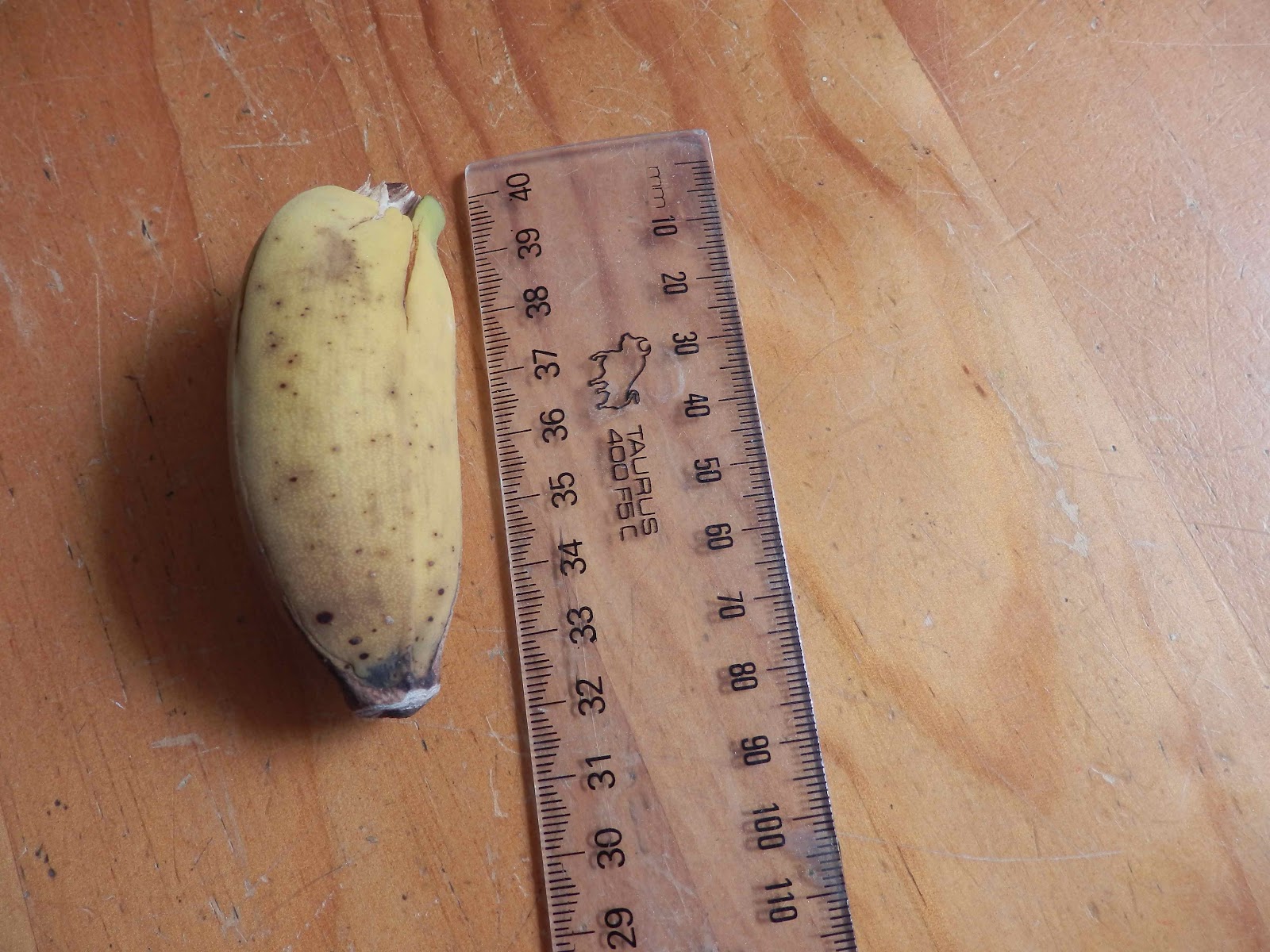
bananas can grow and ripen in Melbourne

For weeks I've walked past a house in Melbourne with a banana plant in the front yard.  Not many people grow them here, because it's thought the climate is too cold. However, I had heard that's not true, so it didn't seem so very out of the ordinary. 


But this plant had fruit  on it. And that's rare so far south.

So today, when I noticed the bunch had disappeared, I just had to open the front gate, walk up the path and knock on the door to ask whether the fruit had ripened.


And it had! I wouldn't have thought the tail-end of a cold winter was the time to harvest a tropical fruit.
Not only did the lady who came to the door answer my question, but she gave me a banana to take home.


As you can see, it was only about nine centimetres (3 1/2 inches) long. But it was delicious, sweeter than the bananas we buy from the shop.

My dog, Penny loves bananas, but she didn't get any of this precious one.


We sometimes like to joke that Penny goes bananas for bananas. I wondered where the expression comes from. The origin of the phrase is unclear. Some say that it relates to the old expression to go ape, because of the connection with apes eating bananas. There's a theory that it might be connected to the myth that eating banana skins can give a hallucinogenic experience.

World Wide Words says the phrase to go bananas dates only from the 1960s.
What of to go bananas? It burst upon the world in the 1960s and became a fashionable, not to say faddish, term in the 1970s. Its heyday is over, perhaps thankfully so. But nobody seems to have any very clear idea where it came from. Was the idea of something bent at the root of it, so that a person was being driven mentally out of shape? Or was there a mental image of an over-excited ape clamouring for his daily feast? Or was it a more subtle image connected with the older phrase to go ape or evento go nuts? You can go crazy thinking about this stuff.

By the way, in researching this topic, I've been reassured that bananas are okay for dogs to eat. (There's a good photo of a banana plant at the ASPCA site.)

Saturday, 1 September 2012

dancing the dishes

Having a set of bowls like these could make washing the dishes a pleasure. (Note I said 'could'. I'm not sure this task is ever enjoyable.)


I love the fact that these Polish homewares come in a range of colors that go delightfully together, because I think it's fun to have different patterns in my set.

I did already have some bowls, but we were expecting family to share dinner with us yesterday, so I dashed off to The Cup and Mug and bought three more.

As I was chatting to the owner of the business  I realised one of the patterns has polka dots on it.

 The word polka, according to Polish Language Blog on Transparent Language, means Polish woman:
Theories on the origin of the polka have been well explored before. Briefly, the music and dance are of Bohemian (Czech) origin. It was called the polka either after the Czech word for “half” in reference to the dance’s characteristic half-step, or in sympathy for the Poles’ 1830 uprising. The very word “polka” means Polish woman in the Polish language. One theory says that it may have been a Polish folk dance borrowed by the Bohemians. Another says it has Gypsy roots. Some say it can even be traced to a single person, a Bohemian girl named Anicka Chadimova.
I like my Polish 'Polish woman' bowl. (I like the others too.)


Friday, 31 August 2012

origin of the call coo-ee

I received an email today called Coo-e-News. I think that's a clever title for the newsletter, because it's about Indigenous Community Volunteering, which relates to the word coo-ee, and it's online, so it's an example of e-News.

I'm rather embarrassed to admit that until I went to the Napoleon Exhibition in Melbourne a couple of days ago, I hadn't given any thought to the origin of 'coo-ee', this typically Australian word.

The Napoleon Exhibition was bound to be enjoyable, because of the fascination of this powerful historic figure. But for Australians it's particularly worth a visit because of the focus on Napoleon and Josephine's interest in the exploration of Australia. To me, as a lover of word origins, it was interesting to read that the first recording of the cry 'coo-ee' was made by a Frenchman.

 The Free Dictionary defines cooee as
a call used to attract attention, esp (originally) a long loud high-pitched call on two notes used in the Australian bush vb cooees, cooeeing, cooeed, cooeys cooeying, cooeyed (intr) to utter this call n Austral and NZ informal calling distance (esp in the phrase within (a) cooee (of)) [from a native Australian language]
This article on the website of The State Library of New South Wales explains:
Francis Barrallier (1773-1853) was one of the colony's earliest French settlers. Escaping to England with his parents when Napoleon took Toulon in 1793, Barrallier embarked on the Speedy to join the NSW Corps in November 1799, reaching Sydney in April 1800... Napoleon ordered the Baudin expedition, 1800-1804, to conduct a survey of the Australian coastline... Barrallier also took an enlightened interest in the local Aboriginal people and he is believed to have first recorded the Aboriginal call 'coo-ee' which Pierre-Francois Bernier (1779-1803), astronomer to the Baudin expedition (1800-1804), set to musical notation.

I began to wonder which indigenous language was the origin of this word. Various languages are suggested on internet sites, but Richard White at the University of Sydney says it was a surprisingly widespread usage at the time of European arrival in Australia.
Aborigines had used it in various ways, but the remarkable thing is that it seems to have had widespread use throughout Australia, spreading well beyond normal linguistic borders (Hunter had recorded it in NSW, Flinders in Western Australia, Tasman - possibly - in Van Diemen’s Land). Less remarkable when the cooee is acknowledged as a communication and navigational technology, a superbly effective forerunner of GPS, rather than as a word, which Europeans persisted in reading it as.

The article ends by saying that although the word has played a major role in the rise of Australian national sentiment, it is unfashionable nowadays. White adds, 'I was surprised to discover that the vast majority of Australian students in my Australian History class had cooeed in the bush at least once.'

I've cooeed. It's fun. (You have to do it in the bush for the best effect.) 

 If you'd like to hear it, you could listen to this podcast.

Monday, 27 August 2012

Plumb puddings or plum puddings?

Today I visited the Napoleon exhibition at the National Gallery of Victoria. It was presented in a fascinating way so that visitors had a sense of experiencing the story of the French Revolution and the rise and fall of Napoleon.

 Having a keen interest in words, I was surprised to see a James Gillray cartoon from 1805 titled The Plumb Pudding in Danger. It is a caricature of the English Prime Minister of the time, William Pitt, slicing up the world, sharing with Napoleon Bonaparte.

 The modern spelling of this dish is plum pudding. I've never taken notice of the fact that there are no plums in it. So I wondered whether the spelling plumb is a more accurate one.

  The Free Dictionary quotes the Farlex Trivia Dictionary:
plum pudding - So named because it was originally made with plums—the word was retained to denote "raisin," which became the main ingredient.
An article from The West Australian newspaper Sat 31 December 1935 refers to an eighteenth century recipe for a boiled 'plumb pudding'.

What's Cooking America , giving an overview of the history of the name, says there were never plums in plum pudding.

In researching this post I became aware of another thing I've never paid attention to - we use the word prune to refer to dried plums. The Online Etymology Dictionary says plum comes from the Latin pruna, and that the change of Latin pl words to pr is unique to the Germanic languages:

plum (n.) Look up plum at Dictionary.comO.E. plume, early Germanic borrowing (cf. M.Du. prume, O.H.G. phruma, Ger. Pflaume) from V.L. *pruna, from L. prunum "plum," from Gk. prounon, later form of proumnon, from an Asiatic language. Change of pr- to pl- is unique to Germanic. Meaning "something desirable" is first recorded 1780, probably in reference to the sugar-rich bits of a plum pudding, etc.
The prunus trees that are so lovely and so useful in our gardens include the plum, of course, but I also love cherries and apricots.